If you've shopped for IPTV at all, you've seen two phrases over and over: "M3U URL" and "Xtream Codes". They're almost the same thing under the hood, and almost every modern player supports both, but the choice does matter — they fail in different ways, and switching from one to the other is often the cheapest fix when something is broken.
This is a working IPTV user's comparison, not a protocol breakdown.
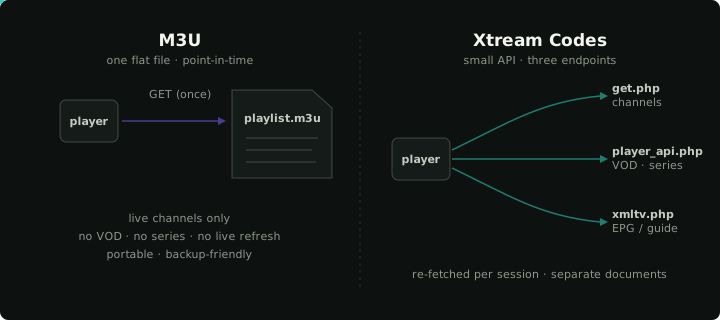
M3U is one fetch of one file; Xtream is a small API the player keeps talking to.
What they actually are
M3U is a flat text file. Open one in a text editor and you'll see a header (#EXTM3U), then a sequence of #EXTINF:… lines pairing each channel with a stream URL. It's about as simple a format as exists. Your player downloads the file once, parses it, and now has a channel list.
#EXTM3U
#EXTINF:-1 tvg-id="twn1" group-title="UK",Tidewater One HD
http://provider.example/live/twn1/index.m3u8
That's the entire data model: a list of channels, each with a name and a URL. Nothing dynamic. If you want a refreshed list, you re-download the file.
Xtream Codes is an HTTP API. You give the player a server, a username, and a password; the player calls a handful of endpoints (get.php?type=m3u_plus, player_api.php, xmltv.php) to fetch the channel list, the VOD library, the series catalog, and the guide as separate documents. The actual stream URLs are constructed by the player from the credentials and the channel ID.
Mechanically, an Xtream login almost always returns an M3U as one of its endpoints — when you "import an M3U" from an Xtream provider, you're using one specific call out of the API. The reverse isn't true: a plain M3U doesn't expose anything else.
When to pick each
Use M3U if:
- You only care about live channels. M3U doesn't have any concept of VOD or series catalog; if your provider ships those, M3U won't show them.
- You want to keep a local snapshot. The M3U file is portable — back it up, edit it in a text editor, share a curated subset with someone else.
- You don't trust the provider to stay around. An exported M3U keeps working for as long as the stream URLs in it work, even if the provider's API endpoint disappears tomorrow.
- The provider is buggy. M3U has fewer moving parts. If their Xtream API is flaky but the M3U export works, just use the M3U.
Use Xtream Codes if:
- You want VOD and series. They simply don't appear over plain M3U.
- You want categories the player can use natively. Xtream sends "live", "VOD", "series" as separate trees; M3U has only
group-titlestrings, which are conventional but not structured. - You change devices often and don't want to re-import. The Xtream credentials work everywhere, and any compatible player will pick up exactly the same library from them.
- You want the player to dynamically refresh the channel list. Xtream re-fetches per session; M3U is point-in-time.
How to know which yours is
If you signed up with a provider and they sent you a single line like:
http://server.example:8080/get.php?username=ABC&password=XYZ&type=m3u_plus&output=mpegts
That's an M3U URL. You can paste it directly into the M3U tester to check it works.
If they sent you three things — a server URL, a username, a password — that's an Xtream login. Most modern players have a separate "Add Xtream source" form. Most providers happily expose both: the same credentials work over both interfaces, and you can use the M3U tester to verify the playlist endpoint and the EPG validator to verify the guide endpoint, all without installing anything.
Common failure modes (and which form to switch to)
The same provider can be perfectly healthy on one interface and broken on the other. Six failure modes are worth knowing.
M3U returns HTML
You paste the URL into the tester and get "the server returned an HTML page". This usually means the M3U endpoint requires a session cookie, or your provider has rate-limited the IP that's hitting it. Try Xtream — the API endpoints are often less aggressively gated than the M3U bulk export.
Xtream returns "auth failed" but M3U works
Some providers update their Xtream credential database on a delay. The M3U URL is signed at issue time and keeps working; the API rejects you because it hasn't picked up the new password yet. Wait an hour, or just use the M3U.
One player can read it, another can't
Xtream Codes is a de facto spec, not a real one. There are providers who claim Xtream support but only implement two of the standard endpoints; there are players that hit a non-standard endpoint and fail when it's missing. If a player can't read your Xtream provider but reads M3U fine, switch to M3U. The reverse is rarer but happens.
Channel logos missing on M3U, present on Xtream
In M3U, logo URLs are inline (tvg-logo="…"). In Xtream, they're served by a logo endpoint. If your M3U has malformed or stale logo URLs, switching to Xtream will repopulate them. The reverse case (logos in M3U, missing in Xtream) almost never happens.
EPG attaches to channels in one form but not the other
The XMLTV <channel id="…"> has to match tvg-id="…" in M3U or the channel-id field in Xtream. These IDs aren't always the same in both formats — providers occasionally regenerate them on a schedule. If your guide is empty in M3U but populated in Xtream, the IDs mismatched in M3U; just use Xtream.
One form is faster
Xtream over a slow network does a lot more round trips than M3U does. On a flaky connection, the difference can be 5–10 seconds at startup. M3U downloads once and keeps going from local data. If first-launch speed matters to you, M3U usually wins.
What Klipa does
Klipa supports both, treats them as interchangeable sources (you can have one M3U and one Xtream login alongside each other in the same library), and re-fetches both in the background. If the M3U starts returning HTML, the Xtream session keeps your channel list alive until the next refresh. If Xtream auth breaks, the cached M3U keeps working.
The strong recommendation is: pick whichever your provider offers more reliably, but don't be loyal to one form. The format isn't the product. The channels are.